.webp)

Dental Implants
Restore missing teeth with durable, natural-looking implants that improve function, confidence, and long-term oral health.
At Paulton Dental & Implant Centre, we are proud to offer dental implants from an experienced team.
With personalised care and attention to delivering a comfortable and seamless journey to a brighter smile, our expert team utilises the latest technology to deliver durable and high-quality dental implant treatments. Restore your radiant smile and improve oral health with us.
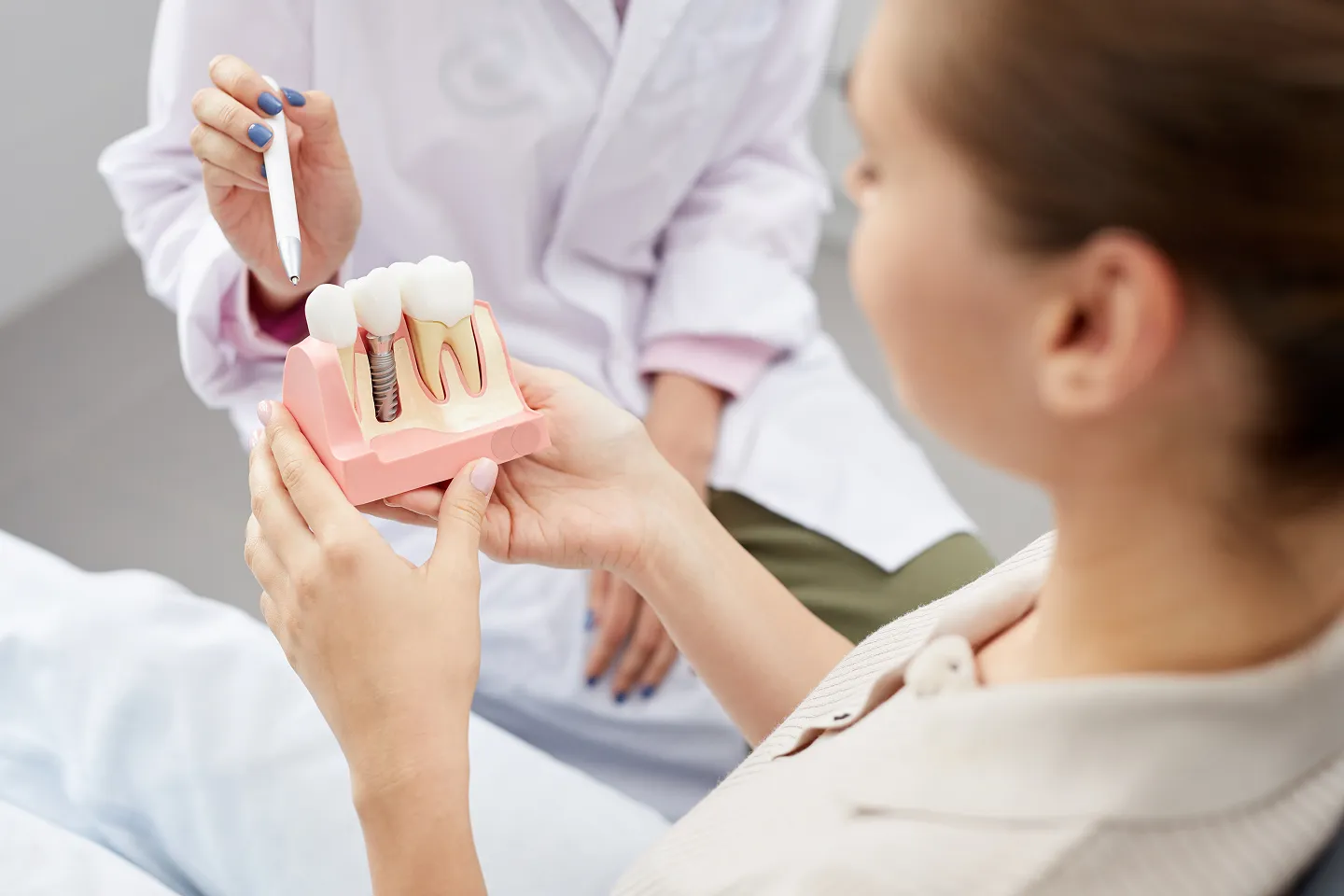
A dental implant is the closest thing to your natural tooth. It has an artificial root that replaces the natural root of a missing tooth or a number of teeth. A dental implant becomes the foundation for any future restoration, as it can support the addition of a crown or a bridge. Dental implants can also anchor dentures, if they are needed in future treatments.
Dental implants are made of a titanium alloy, which is a biocompatible material; therefore, this means the human body does not perceive the dental implant as a foreign object in the jawbone, and this minimises the risk of implant rejection or failure.
After the implant is placed, the healing process consists of the dental implant melding into the jawbone. The outcome leads to a strong and new artificial root ready to support any type of restoration.
At Paulton Dental & Implant Centre, we are proud to utilise the Straumann Implant System. As the leading brand in Dental Implants, Straumann offers a high-quality, highly successful dental implant system, giving you security in your decision for a long-lasting result. Straumann has been a top force in the dental implant realm for over 70 years, and works closely with us to ensure the best outcomes for our patients.
Does It Hurt?
Dental implants are a surgical procedure which may seem daunting; however, due to the use of local anaesthesia, the treatment is pain-free.
At Paulton Dental & Implant Centre, we understand that dental implant treatment can cause anxiety; therefore, if you have any fears or questions regarding dental implants, don’t hesitate to call or book a consultation, and our dentists can talk through the whole process, ensuring you are comfortable and confident.
How Is It Done?
The treatment is generally executed in two stages: the surgical (when the titanium root is placed into the jawbone) and the restorative (when the crown, bridge or denture is fitted on top of the implant). Simply explained, a root is placed, and then a crown, which has the appearance of a tooth, is placed over the top.
Between the surgical and the restorative stage, there is a healing time of three to six months, depending on each clinical case. In certain circumstances, a temporary type of restoration can be used; therefore, the patients are not toothless at any point during the treatment.
The dental implant is made of titanium, which is a biocompatible material, meaning the human body does not sense the presence of a foreign object in the jawbone. This minimises the risk of implant rejection or implant failure. Statistically, the average failure rate for an implant is between 2%-3%.
The entire procedure is perceived by the human body as a wound, and as part of the healing process, the dental implants meld into the bone by a process called osseointegration.
The outcome is a strong new artificial root ready to support any type of restoration. Implants are a long process, and we usually book patients in for numerous sessions for preparation and placement. However, this can sometimes be sped up using immediate implant placement techniques. Speak to your dentist for more information on this.
We also understand that dental implants are an expensive procedure, and therefore, we offer 0% finance through Tabeo here at Paulton Dental & Implant Centre to aid in payment.
How Can They Be Used?
Dental implants can be used in cases of one or more missing teeth. For one missing tooth, the implant is used as a root to support a crown restoration. When more teeth are missing, a minimum of two dental implants can be used to support a bridge, replacing all the missing teeth and if there is a larger gap, a higher number of implants have to be placed.
In the cases where all teeth are missing (known as being ‘fully edentulous’), implants can be used to retain/support dentures, offering a stable denture restoration.
If patients suffer from a severe gag reflex, they can benefit from dentures supported by implants, as they are available palate-free. Palate-free dentures have numerous positives, including comfort and improved speech.
Is My Bone Strong Enough To Take An Implant?
An important factor when considering a dental implant is the jawbone, as it is the supporting structure of the dental implant. Dental implants come in various sizes; however, a minimal amount of bone is necessary to allow for a dental implant to be placed. Usually, if there are any issues with the jawbone, our dentist will disclose this beforehand, therefore allowing patients the most accurate and advantageous treatment plan.
In the cases of insufficient bone volume, bone grafting procedures are available to enhance the bone volume and to allow for implant placement. There are a variety of products that can be used for bone enhancement, such as:
- An artificial bone substitute.
- The patient’s own bone was harvested from another area of the mouth.
- Dental membrane, which can be used to guide tissue and bone regeneration.
- PRF platelet-rich factors) which uses the patient’s blood to create a stable blood clot enriched with growth factors that are beneficial for the regeneration of the bone.
- Animal bone (porcine/bovine, which goes through a very rigorous sterilising procedure, serves as a matrix or scaffold to induce natural human bone growth.
Our dentist will recommend the most beneficial treatment for each patient, and will therefore provide you with all the information about the treatment that is best suited.
Benefits Of Dental Implants
- Dental Implants help prevent gradual bone deterioration as they mirror the action of the original root, transmitting chewing forces to the jawbone in a natural way. Implants also help maintain the health of the bone and keep the jaw in shape. This is not the case with conventional methods, such as bridges or partial prosthesis.
- Unlike a conventional bridge, the healthy neighbouring teeth remain intact without having to be ground down to support the implant, and implants also don’t require extensive care. Once an implant has healed, it merges with the body, therefore acting like a natural tooth and root. An implant-borne restoration looks exactly like a natural tooth, and implants are comfortable and convenient.
- Implants allow you to regain your quality of life and say goodbye to negative experiences associated with missing teeth, such as self-consciousness, insecurity, and permanent discomfort, which can be a cause of ill-fitting dentures.
Dental Implants help prevent gradual bone deterioration as they mirror the action of the original root, transmitting chewing forces to the jawbone in a natural way. Implants also help maintain the health of the bone and keep the jaw in shape. This is not the case with conventional methods, such as bridges or partial prosthesis.
Unlike a conventional bridge, the healthy neighbouring teeth remain intact without having to be ground down to support the implant, and implants also don’t require extensive care. Once an implant has healed,ity merge with the body, therefore acting like a natural tooth and root. An implant-borne restoration looks exactly like a natural tooth, and implants are comfortable and convenient.
Implants allow you to regain your quality of life and say goodbye to negative experiences associated with missing teeth, such as self-consciousness, insecurity, and permanent discomfort, which can be a cause of ill-fitting dentures.
How Long Do They Last?
Unfortunately, nothing lasts forever, and therefore, the dental implant restoration might require further attention or, in some cases, even replacement. However, dental implants are very reliable as long as they are cared for.
Can Implants Fail?
Implants rarely fail. Studies show that dental implants have a great survival and success rate. Implantology is now so advanced that failures owing to rejection or functional problems are relatively rare.
If implant failure is a concern, you can discuss this with the dentist for further reassurance. Our team is happy to answer any questions regarding implant procedures.
What Causes Dental Implants To Fail?
Smoking inhibits blood flow and affects the healing process after implant surgery. Even after the implant has successfully integrated with the bone, smoking can cause inflammation, infection and ultimately, lead to implant failure.
Oral hygiene also plays a key role in the long-term success of the dental implant restorations. Keeping your mouth clean will prevent gum inflammation, infection and subsequently gum disease. However, if gum disease is present, this can affect dental implants, as gum disease can cause the jawbone to recede from around the roots of the natural teeth as well as dental implants. This can result in tooth mobility and failure of the teeth or implants; therefore, oral hygiene is imperative when considering implant care.
Learn More About Dental Implants
What are dental implants and how do they work?
Who is a good candidate for dental implants?
How long do dental implants last?
Are dental implants painful to get?
How much do dental implants cost at Paulton Dental & Implant Centre?
Get in Touch
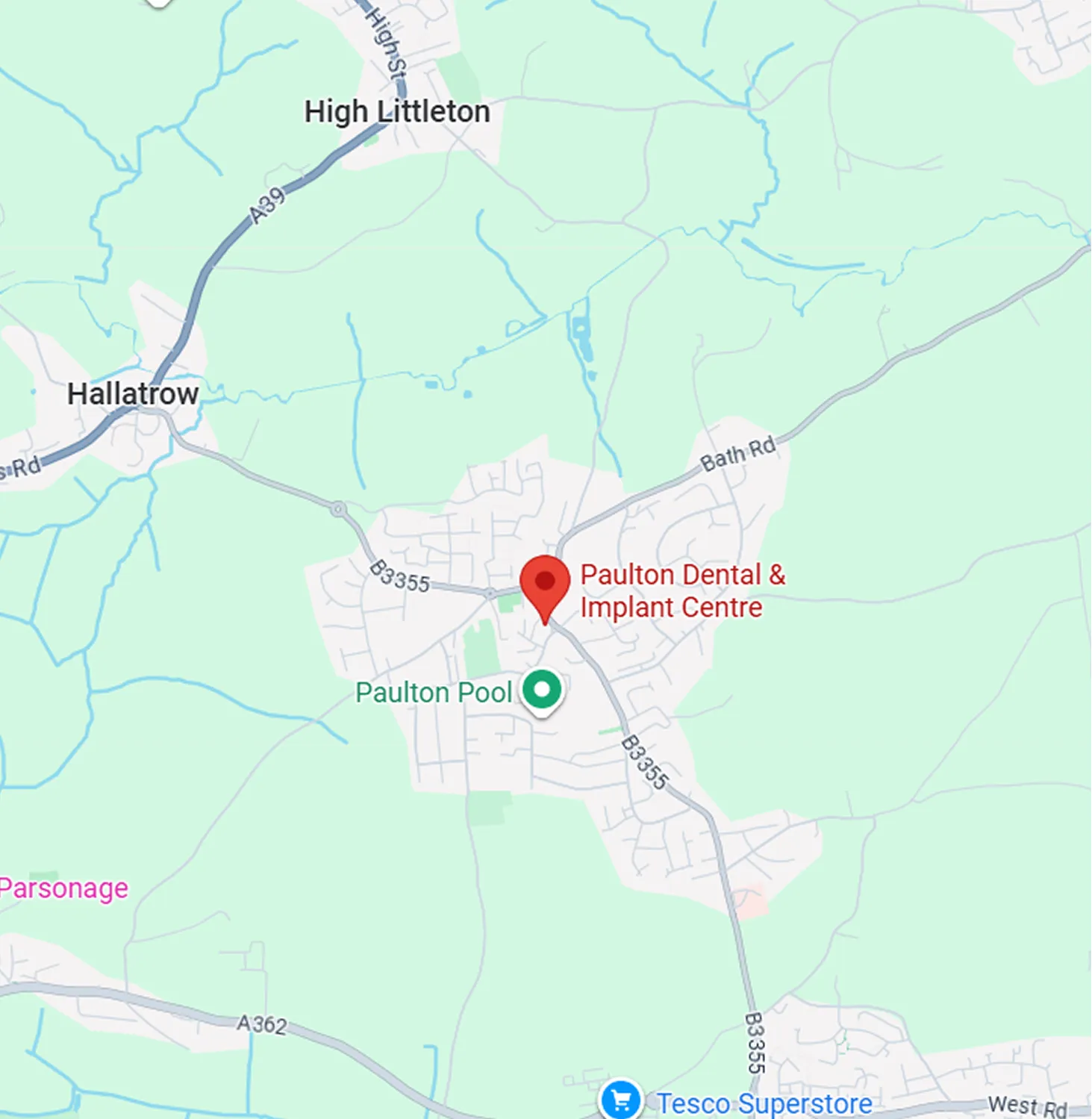
Let’s Create the Smile You Deserve.
Book your smile consultation today and take the first step towards a confident, healthy smile.


Hear From Our Happy Patients

The Dentist was very helpful as he talked me through the procedure at every stage. His bedside manner was gentle and kind.
He also made recommendations that I appreciated, so I hope I see him again at my next appointment.
Dentist explained everything he was doing and felt very safe and comfortable
Dental Insights & Tips
Explore our blog for expert advice, treatment
insights and oral care tips.
.png)
How to Choose a Cosmetic Dentist in Somerset
Discover how to choose a cosmetic dentist in Somerset, including experience, technology, and treatment options for safe, effective smile enhancement.

Cosmetic Dentist in Paulton: What to Look For
Learn how to choose a cosmetic dentist based on expertise, technology, and treatment options to achieve safe, natural-looking smile results.

Cosmetic Dentist vs General Dentist: What’s the Difference?
Discover the difference between cosmetic and general dentists, their treatments, and which one to choose for your oral health and smile goals.